
Climate KOLs on Twitter
Who actually steers the online climate debate? A network map of the 200 most influential voices — and why the household names aren't on top.
Key opinion leaders — the accounts a network actually routes its information through — are rarely the ones with the biggest follower counts. My undergraduate thesis scraped ten days of the English-language climate-change conversation on Twitter (March 2022) via Gephi's Twitter Streaming Importer: 265,000 accounts joined by 684,000 retweets, @mentions, and quotes. Ranking every actor by eigenvector centrality and hand-coding the 200 most central into eight categories reveals a debate structured not by its famous names but by activists, scientists, and organizations who work the platform's mechanics — with a right-wing periphery of climate deniers clinging to the edge.
Research Questions
- Do the household names of climate — the UN, Greta Thunberg, Greenpeace — actually dominate the network, or does its structure reward something else?
- Which category of actor holds the most central position in the debate?
- What makes an actor central: followers, sheer activity, strategic networking, or thematic specialization?
The data
The network was collected with Gephi's Twitter Streaming Importer over the first ten days of March 2022 — a deliberately ordinary stretch with no summit or catastrophe to distort it — filtering the live stream to English-language posts carrying the keywords 'climate change' or 'global warming'. Only three kinds of social interaction were kept as edges: retweets, @mentions, and quotes, the tie-types that survive a network analysis intact. The result is a graph of 265,000 accounts and 684,000 connections. The study was originally designed as a cross-platform comparison with Weibo, but Weibo's restrictive data access — an API that rejects overseas applicants, follower lists capped at 200, and reposts that never surface in search — yielded a dataset too thin and too skewed to compare honestly, so this write-up stays with the Twitter network.
A three-way split
Rendered in full the graph is a spectacle more than an argument, so the 10,000 most eigenvector-central nodes were laid out with ForceAtlas2 and left to fall into three rough regions. At the center sits a dense yellow core: the best-known international organizations (UN, IPCC, COP26, WRI) and the activists, bloggers, and scientists who constantly reference them — Greta Thunberg beside Bill McKibben, Michael E. Mann, and Saleemul Huq. What is striking is how often the scientists, despite modest follower counts, act as the connective tissue between otherwise isolated clusters. A broad blue cluster of commentators, celebrities, and public figures spreads out beside it, leaning distinctly left. On the far side, a looser orange cluster runs from moderate to alternative-right, and the further an actor sits toward its edge, the more its posts read as opposition to the political mainstream — this is where the climate skeptics concentrate.
The elite network
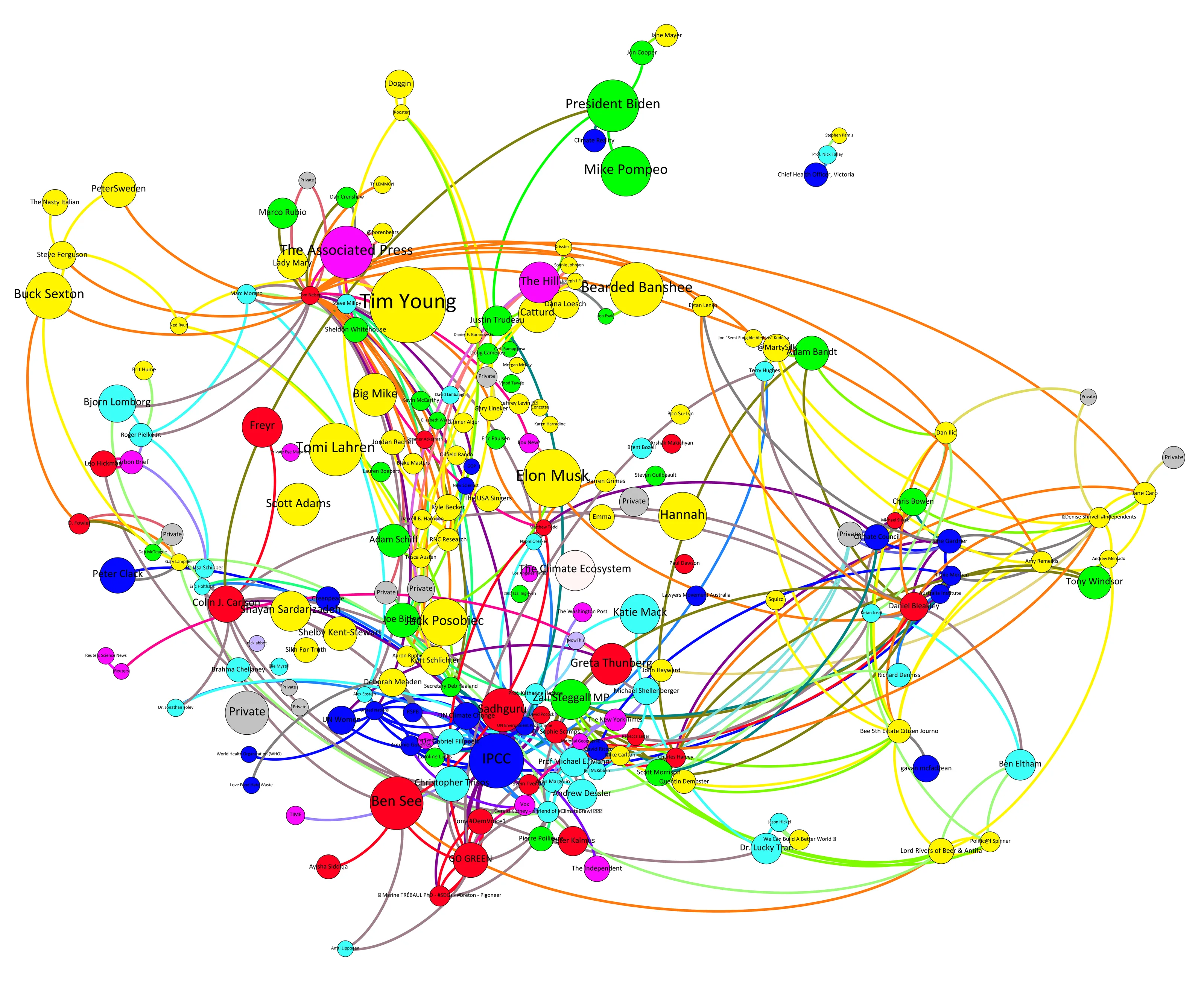
To cut through the volatility of a ten-day snapshot, the analysis descends to the 200 actors with the highest eigenvector centrality — the measure that rewards being connected to other well-connected accounts, i.e. macro-scale influence rather than raw reach — and hand-codes each into one of eight categories from its profile, description, and recent posts. The layout is legible: environmental activists, organizations, and scientists pack the bottom-left, media nearby; bloggers and public figures rise toward the top. The surprise is how many state actors surface in the upper reaches — less a sign of thematic closeness than of the fact that commentators and bloggers direct their posts at politicians, while activists and organizations rarely do.
What makes an actor central
The counterintuitive ranking resolves into three mechanisms. Activity: influence is visibility per post times number of posts, so ICCCAD's Saleemul Huq — with a hundredth of Thunberg's five million followers but thirty times the posting volume — reaches a third of her centrality. Strategic networking: eigenvector centrality rewards reciprocal ties inside the relevant bubble, the cooperation that scientists and environmental organizations excel at, while betweenness rewards bridging otherwise unconnected clusters. And thematic specialization: the IPCC matches its institutional parent's centrality with a tenth of the posts and two percent of the followers, simply because nearly everything it publishes is on-topic. Together these explain why the perceived giants of the debate — the ones you would name on the street — sit lower than topic-focused scientists and bloggers who never leave the subject.
Who leads the debate
Public figures — commentators, bloggers, influencers — are the single largest category, roughly a third of the elite network, which mainly shows that climate change is a mainstream concern rather than the property of a few dedicated stakeholders. But the quarter of the network made up of activists and scientists is what distinguishes Twitter: these categories hold several of the very highest eigenvector and betweenness scores, the marks of a mature debate in which even climate deniers cannot avoid referencing the activism–science–institution core. State engagement, by contrast, is personal rather than institutional — politicians' own accounts, rich in followers but thin on activity — suggesting that on Twitter the state shows up through individual commitment, not coordinated presence.